| BRENT: $93.34 | WTI: $88.12 | GASOLINE: $2.45 | NATURAL GAS: $2.12 |
|-----------------------------------------------------------|
## Quick Facts
* **Partnership**: Intercontinental Exchange (ICE) and OKX collaborating on institutional-grade energy derivatives.
* **Product**: Perpetual swap contracts based on global Brent and WTI benchmarks.
* **Availability**: 24/7 trading access with no monthly contract expirations.
* **Market Reach**: Available to over 120 million registered users on the OKX exchange.
* **Benchmark Authority**: ICE Brent tracks approximately 75% of the world's traded oil.
* **Settlement**: Continuous margining and real-time funding rate mechanisms to align with spot prices.
* **Liquidity**: Direct price licensing from ICE ensures lower tracking error compared to third-party oracles.
Intercontinental Exchange (ICE) and OKX have partnered to launch perpetual futures contracts tied to global Brent and WTI crude oil benchmarks. These instruments allow traders to maintain exposure to oil prices indefinitely without the need to roll contracts monthly. By utilizing a funding rate mechanism, the price of these perpetuals remains closely aligned with the underlying spot or traditional brent crude oil futures benchmarks.
The primary difference between traditional brent crude oil futures and perpetual contracts is the absence of an expiration date and 24/7 market availability. Traditional futures operate during set exchange hours and expire monthly, whereas perpetuals utilize continuous margining and real-time settlements. This structure allows for instant liquidations and price discovery that continues through weekends and holidays, reacting immediately to geopolitical supply shocks.
## The Partnership: ICE and OKX Bridge TradFi and Crypto
In the world of global finance, the bridge between Traditional Finance (TradFi) and the digital asset ecosystem is often built on infrastructure. The recent partnership between Intercontinental Exchange and OKX represents a massive leap in this integration. ICE is not just any financial entity; as the parent company of the New York Stock Exchange (NYSE), it represents the bedrock of institutional benchmarks. By licensing its energy data to OKX, ICE is effectively legitimizing the crypto-native perpetual swap as a vehicle for serious commodity trading.
This collaboration brings global oil benchmarks to the platform of OKX, providing its [more than 120 million users](https://www.ledgerinsights.com/ice-to-license-oil-benchmark-prices-for-perpetual-futures-on-crypto-exchange-okx/) with access to perpetual units based on ICE Brent and WTI crude oil prices. For the retail trader, this means high-level access once reserved for hedge funds. For the institutional side, it marks a significant phase of institutional adoption where crypto exchanges are treated as viable venues for legacy assets.
The weight of this partnership is anchored in the data itself. The ICE Brent Crude benchmark, which will underpin the new OKX perpetual contracts, serves as the pricing standard for [approximately three-quarters of the world's internationally traded oil](https://www.ledgerinsights.com/ice-to-license-oil-benchmark-prices-for-perpetual-futures-on-crypto-exchange-okx/). When a crypto exchange gains the right to use this data directly, it removes the "oracle risk" often associated with decentralized or unregulated platforms.
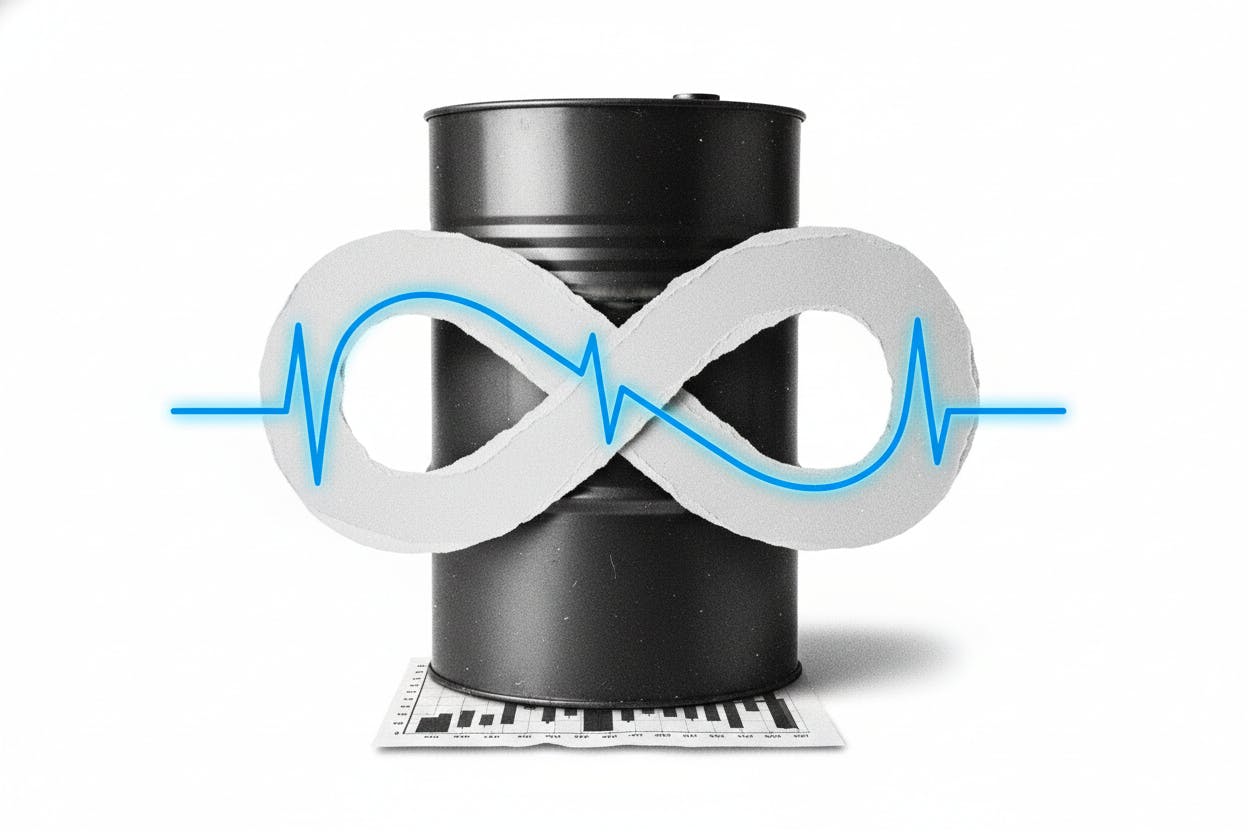
## Perpetual Swaps vs. Traditional Futures
Understanding how to trade brent crude oil futures in a crypto environment requires a shift in how we view contract expiry. In the traditional world, oil futures represent a promise to buy or sell a specific amount of oil at a future date. Traders must "roll" these contracts every month to avoid physical delivery, which often results in price slippage or "contango" losses.
Perpetual swap contracts solve this by removing the expiration date entirely. To keep the price of the perpetual contract tethered to the actual brent oil price live, the exchange uses a funding rate. If the perpetual price is higher than the index price, long positions pay shorts. If it is lower, shorts pay longs. This constant balancing act ensures that the brent crude oil futures funding rates explained to new users are seen as a mechanism for stability rather than just a fee.
| Feature | Traditional ICE Brent Futures | OKX Oil Perpetual Swaps |
| :--- | :--- | :--- |
| **Trading Hours** | Set Exchange Hours (Close on Weekends) | 24/7/365 |
| **Expiration** | Monthly / Quarterly | No Expiration (Perpetual) |
| **Settlement** | Physical or Cash at Expiry | Continuous Real-Time Settlement |
| **Margining** | Initial and Maintenance Margin | Continuous Margining (Auto-Liquidation) |
| **Price Feed** | Exchange Order Book | ICE Index + Funding Rate Mechanism |
For a brent vs wti oil futures for beginners guide, the choice often comes down to regional focus. Brent is the international standard (extracted from the North Sea), while WTI (West Texas Intermediate) is the US benchmark. OKX is providing both, allowing for complex spread trading strategies that were previously difficult to execute for crypto-native users. The brent crude oil futures contract specifications on OKX are designed to mirror the underlying volatility of the ICE benchmarks while maintaining the high leverage and accessibility typical of digital wallets.
## 24/7 Market Access: Geopolitical Discovery
One of the most profound impacts of this launch is the transition to a 24/7 global energy market. Traditional energy derivatives take a break over the weekend, but geopolitical supply shocks do not. If a crisis erupts in the Strait of Hormuz on a Saturday afternoon, traditional traders are stuck watching the news until the market opens on Sunday night or Monday morning.
Trading brent crude oil perpetual futures on a crypto-native infrastructure introduces round-the-clock volatility management. Because these contracts use continuous margining, positions can be liquidated in real time if collateral thresholds are breached. This 24/7 environment means that market-moving news occurring outside of traditional trading hours may reflect in perpetual prices first, potentially influencing the opening prices of conventional commodity markets via arbitrage.
Investors who utilize a brent crude oil price chart to time their entries can now see price action developing in the "dark hours" of the traditional exchange. This creates a new price discovery phase where the crypto market acts as a leading indicator for the legacy energy sector. The 24/7 brent crude oil trading strategy focuses on capturing these "out-of-hours" moves before the heavy institutional volume of the NYSE or ICE opens for the week.
## Competitive Landscape: OKX vs. Binance vs. Hyperliquid
While other platforms have attempted to list "synthetic" oil assets, the OKX approach is different because of its direct licensing with Intercontinental Exchange. Many decentralized perpetual platforms use third-party oracles which can suffer from latency or price manipulation. By getting the brent crude oil futures data straight from the source, OKX offers a level of professional-grade precision that competitors struggle to match.
The user base comparison also tells a story of scale. With over 120 million users, OKX provides a depth of liquidity that decentralized competitors often lack. This liquidity is crucial when trading energy derivatives, as a lack of buyers or sellers can lead to massive "wicks" on the chart that trigger unnecessary liquidations. For those watching the brent oil price live, the stability offered by this TradFi-Crypto hybrid infrastructure is a clear professional upgrade.
As more energy derivatives move toward crypto rails, we are seeing a shift from "crypto-exclusive" trading to a world where a digital wallet is the primary interface for any global asset. The ICE and OKX partnership is the blueprint for how energy, metals, and even equities will likely be traded in the coming decade.
## FAQ
### What is the difference between Brent and WTI crude oil?
Brent crude oil is sourced from the North Sea and serves as the global benchmark for about 75% of the world's traded oil. WTI, or West Texas Intermediate, is the primary benchmark for oil produced in the United States and is typically lighter and sweeter than Brent, often trading at a slight price discount.
### How can I trade Brent crude oil futures?
You can trade Brent crude oil through traditional brokers on the Intercontinental Exchange or via crypto platforms like OKX. On crypto exchanges, these are often offered as perpetual swaps, which do not expire and allow for 24/7 trading using stablecoins or other crypto assets as collateral.
### Why is Brent crude oil used as a global benchmark?
Brent is used globally because its waterborne nature makes it easier to transport to various international markets compared to landlocked crudes. Its widespread use by OPEC and major oil-producing nations makes it the most accurate reflection of global supply and demand dynamics.
### What are the trading hours for Brent oil futures?
Traditional Brent oil futures on ICE trade for approximately 22 to 23 hours a day during the business week but are closed on weekends. However, Brent perpetual futures on crypto platforms like OKX trade 24 hours a day, 7 days a week, 365 days a year.
### What are the risks of investing in oil futures?
The primary risks include high price volatility driven by geopolitical events, the cost of funding rates in perpetual contracts, and the risk of liquidation. Because futures often involve leverage, even small price movements against your position can result in the loss of your entire initial collateral.

Market Updates
ICE and OKX Launch 24/7 Brent Crude Oil Futures
Finance News
May 26, 2026
You May Also Like

Economic News
DAX Index Outlook: June PMI Signals Economic Recovery
Jul 15, 2026

Market Updates
Anthropic’s Multi-Cloud Enterprise AI Platform Move
Jul 07, 2026

Market Updates
Market Outlook: US Jobs Report Release & Forecast
Jul 01, 2026

Market Updates
Can Brazil Overtake Argentina in Soybean Crushing?
Jun 25, 2026
Market Updates
Italy Unemployment Rate Drops to 5.1% in April 2026
Jun 08, 2026
Economic News
2-Year Treasury Yield Falls as Bowman Signals Caution
Jun 03, 2026