Quick Facts
- New Jobs: 123,000 positions added in April 2026 (+0.5% MoM)
- Unemployment Rate: Fell to a record low of 5.1%
- Youth Performance: Youth unemployment dropped to 16.9%
- Total Employment: 24,337,000 people currently in the workforce
- Employment Rate: Reached a historic peak of 63.1%
- Year-on-Year Growth: 269,000 more people employed than in April 2025 (+1.1%)
- Inactivity Rate: Decreased to 33.4% as more citizens entered the labor force
In April 2026, the italy unemployment rate fell to 5.1%, outperforming projections as the economy added 123,000 jobs. According to latest ISTAT data, this decline indicates a tightening labor market despite a modest 0.6% growth target for the year, showing strong job creation even amidst sluggish economic expansion.
Quick Facts: Italy's April 2026 Labor Boom
The Italian labor market continues to defy the gravity of broader European economic stagnation. In April 2026, the national workforce expanded unexpectedly, pushing the italy unemployment rate down to levels not seen in decades. This surge in hiring is particularly noteworthy because it occurs against a backdrop of conservative GDP forecasts. Economic analysts had predicted a far more cautious approach from employers, yet the month-over-month increase of 123,000 (+0.5%) in the number of employed persons suggests that business confidence is decoupled from the sluggish headline growth figures.
To understand the scale of this shift, we must look at the overall volume of the workforce. According to the latest ISTAT statistical data, the total number of employed persons has reached 24,337,000. This is not just a seasonal fluctuation; it is part of a sustained upward trajectory that has seen the total employment-to-population ratio climb steadily. When asking what is the unemployment rate in italy today, the answer of 5.1% reflects a market that is increasingly supply-constrained rather than demand-deficient.
| Metric | April 2026 | Monthly Change (%) | Annual Change (%) |
|---|---|---|---|
| Total Employed | 24,337,000 | +0.5% | +1.1% |
| Unemployment Rate | 5.1% | -0.2 pp | -0.6 pp |
| Employment Rate | 63.1% | +0.3 pp | +0.7 pp |
| Youth Unemployment Rate | 16.9% | -0.4 pp | -2.1 pp |
| Inactivity Rate | 33.4% | -0.2 pp | -0.5 pp |
This record-breaking performance has pushed the employment rate to a peak of 63.1%. For context, compared to April 2025, the number of employed persons in Italy rose by 269,000, representing a year-on-year increase of 1.1%. This suggests that the italy unemployment rate 2026 narrative is defined by stability and organic growth in the private sector.
Youth Unemployment: A Historic Downward Shift
Perhaps the most significant victory in the latest ISTAT statistical data is the sharp decline in the youth unemployment rate italy. For decades, Italy struggled with a stagnant youth labor force, with rates frequently exceeding 40% in the aftermath of the 2008 financial crisis. By April 2026, however, the youth unemployment rate reached a historic low of 16.9%. This represents the lowest level since the current statistical series began in 2004, marking a profound shift in workforce demographics.
The transition from a high-unemployment environment to the current state is best visualized by comparing the 2014 peak of 42.7% with the current 16.9%. This improvement is supported by a decrease in the national inactivity rate to 33.4%, signifying a higher degree of labor force participation among younger demographics. While the youth unemployment rate remains higher than the national average, the gap is narrowing at an accelerating pace.
- 2014 Peak: 42.7% (Economic crisis impact)
- 2020 Pivot: 29.5% (Pre-pandemic recovery)
- 2026 Current: 16.9% (Record statistical low)
This downward trend in the italy youth unemployment rate is also reflected in the youth employment-to-population ratio. More young Italians are moving from education or inactivity directly into the workforce, often bypassing the traditional long periods of job searching. However, the labor market tightening has also revealed skills mismatch challenges. Companies are hiring more aggressively, yet they report difficulty finding specialized technical talent, suggesting that while the italy unemployment rate by age is improving, the quality of the match between candidate and role remains a work in progress.
The Productivity Paradox: Growth vs. Hiring
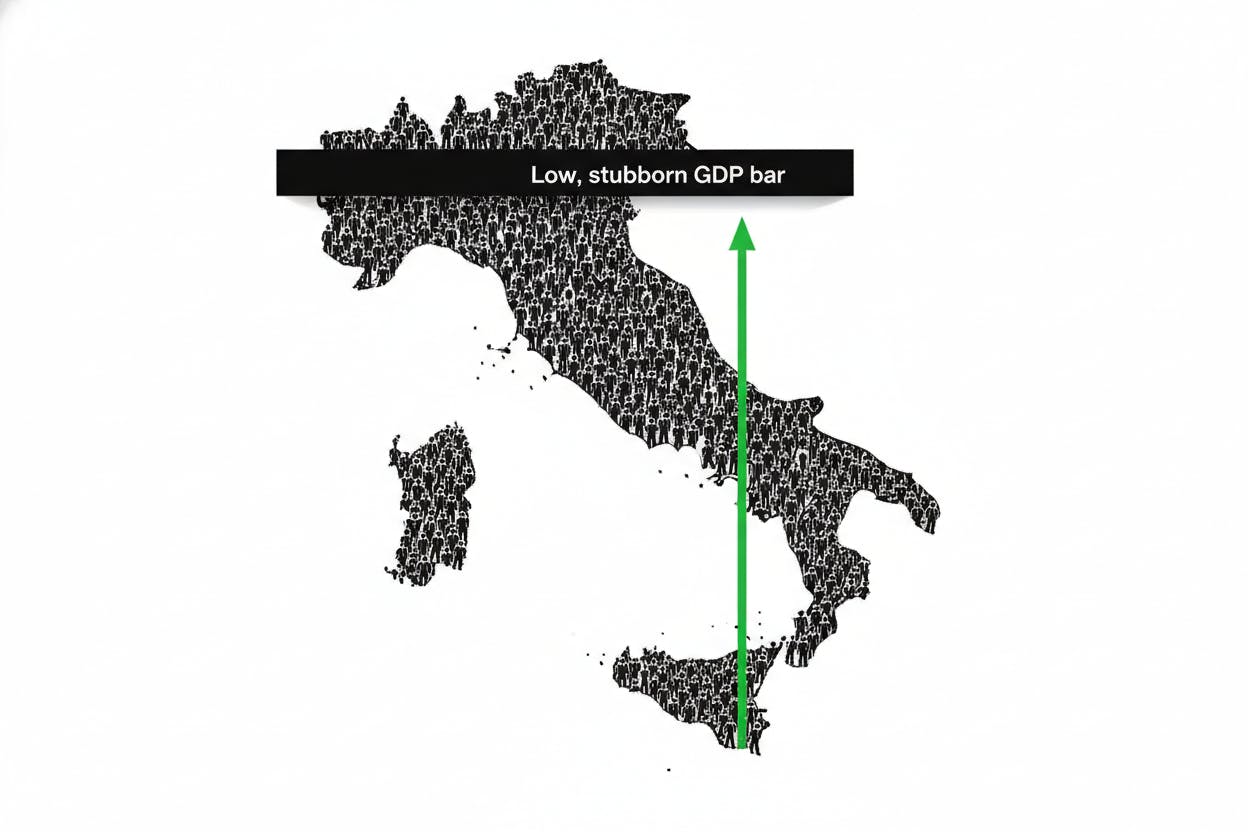
While the headline figures are celebratory, economists are closely monitoring the italy job market productivity vs pay 2026 dynamic. There is a visible productivity paradox currently playing out: the economy is adding jobs at a rate of 1.1% year-on-year, yet national GDP growth is stuck at a modest 0.6%. In a traditional economic model, employment growth and output growth should be more closely aligned. When hiring outpaces economic output, it suggests that labor productivity remains a critical challenge.
This discrepancy has significant monetary policy implications. If labor productivity does not improve, the cost of labor per unit of output rises. This can lead to a squeeze on corporate margins or contribute to wage-push inflation. In the current climate of job market tightening, workers theoretically have more bargaining power, but significant wage growth may be difficult to sustain without improving output per worker.
The increase in labor force participation is a double-edged sword in this context. While fewer people are inactive (as evidenced by the italy inactivity rate trends 2026 showing a drop to 33.4%), the influx of new workers often enters lower-productivity sectors such as tourism or basic services. To move the needle on long-term prosperity, Italy must ensure that the transition from permanent versus temporary contracts promotes long-term investment in worker training and technology.
Regional Disparities and Workforce Composition
Despite the national success, the italy unemployment rate by region reveals a familiar story of geographic inequality. The northern regions, such as Lombardy and Veneto, are operating in a state of nearly full employment, with some provinces reporting rates as low as 3.2%. In contrast, the southern italy unemployment rate remains the primary drag on the national average, though it too is showing signs of moderate improvement.
The labor force participation in Puglia, Sicily, and Calabria has increased, but these regions still face higher structural obstacles. The gender gap also persists, though it is narrowing. The latest data indicates:
- Male Unemployment Rate: 5.7%
- Female Unemployment Rate: 7.3%
The southern reach of the 2026 job boom is largely driven by infrastructure projects funded through EU recovery funds and a resurgence in Mediterranean trade. However, the consumer spending capacity in these regions remains lower than in the North, largely because a higher percentage of the new jobs in the South are concentrated in seasonal or lower-paying industries. Balancing the italy unemployment rate by age and region will require more than just headline job growth; it will require a fundamental shift in the industrial base of the Italian South.
FAQ
Why is Italy's unemployment rate so high?
Historically, Italy has struggled with structural rigidities and a lack of labor market flexibility. However, as of April 2026, the italy unemployment rate of 5.1% is actually lower than many of its European peers. The previous high rates were often attributed to a mismatch between the education system and the needs of the private sector, but recent reforms have significantly smoothed the transition from school to work.
Is there a labor shortage in Italy?
Yes, Italy is currently experiencing a significant labor shortage in specific sectors despite the record-high employment figures. The tightening labor market means that industries like high-tech manufacturing, healthcare, and specialized hospitality are struggling to find qualified workers. This is reflected in the record-high employment-to-population ratio of 63.1%.
Is Italy's economy struggling?
Italy's economy presents a mixed picture. While the labor market is exceptionally strong with 123,000 new jobs added in a single month, GDP growth remains modest at 0.6%. This disconnect suggests that while firms are hiring, the overall efficiency and output per worker (productivity) are not growing at the same pace, which could present long-term challenges for sustained wage increases.
Which European country has the highest unemployment rate?
While the italy unemployment rate has improved to 5.1%, other Mediterranean neighbors often hold the position of having the highest rates in the Eurozone. Typically, Spain and Greece record higher unemployment figures, particularly in the youth demographic. Italy's current figures place it in a much stronger position relative to the EU average than it was a decade ago.
The Path Forward for Italy's Labor Market
As we look toward the second half of 2026, the Italian job market appears to be on a solid footing. The ability to add 123,000 jobs in a single month is a testament to the resilience of Italian small and medium enterprises (SMEs). For job seekers, the message is clear: the market is the most favorable it has been in several generations, with youth unemployment at historic lows.
For investors, the focus must shift from the quantity of jobs to the quality of output. The productivity paradox remains the elephant in the room. If Italy can pair its record-high employment rate with modernization and digital transformation, the current labor boom could transition into a period of sustainable, high-wage growth. For now, the 5.1% unemployment rate stands as a landmark achievement for a nation that has spent years working to revitalize its workforce.