Quick Facts
- Growth Momentum: India’s electronics manufacturing saw a 15% CAGR between 2017 and 2022, with production value jumping from $49 billion to $87.1 billion.
- Market Ambition: The government is targeting a $300 billion domestic electronics market by 2026.
- Global Footprint: India’s share in global electronics manufacturing rose from 1.2% in 2014 to 3.75% in FY 2021-22.
- Primary Goal: PLI 2.0 aims to transition the industry from simple "screwdriver assembly" to deep manufacturing of complex components like PCBAs and memory modules.
- Job Creation: The scheme is a massive employment engine, having already contributed to over 12.6 lakh direct and indirect jobs across various sectors.
The New Era of 'Make in India'
For years, the "Make in India" initiative was often criticized as being "Assemble in India." While the volume of finished goods grew, the soul of the machines—the high-value components—was still arriving in kits from overseas. However, the landscape is shifting rapidly. India’s Production Linked Incentive (PLI) Scheme 2.0 represents a sophisticated evolution in industrial policy, moving away from generic subsidies toward a high-performance, export-oriented model.
At its core, India PLI 2.0 is a revamped incentive scheme that rewards electronics manufacturers not just for producing more, but for achieving high export performance and significantly increasing the use of locally sourced components. It is the government’s primary lever to integrate India into the global "China Plus One" supply chain strategy. With a CAGR of 15% in electronics manufacturing over the last five years, the foundation is already set. The goal now is to deepen that foundation by ensuring that the value added within Indian borders goes far beyond the final packaging.
The Strategic Shift: From Assembly to Value Addition
The transition from PLI 1.0 to PLI 2.0 marks a fundamental change in philosophy. While the first iteration was about getting the big players into the country, PLI 2.0 is about making them stay and build a local ecosystem. The government realized that to reach the $300 billion target by 2026, it couldn't just rely on imported kits.
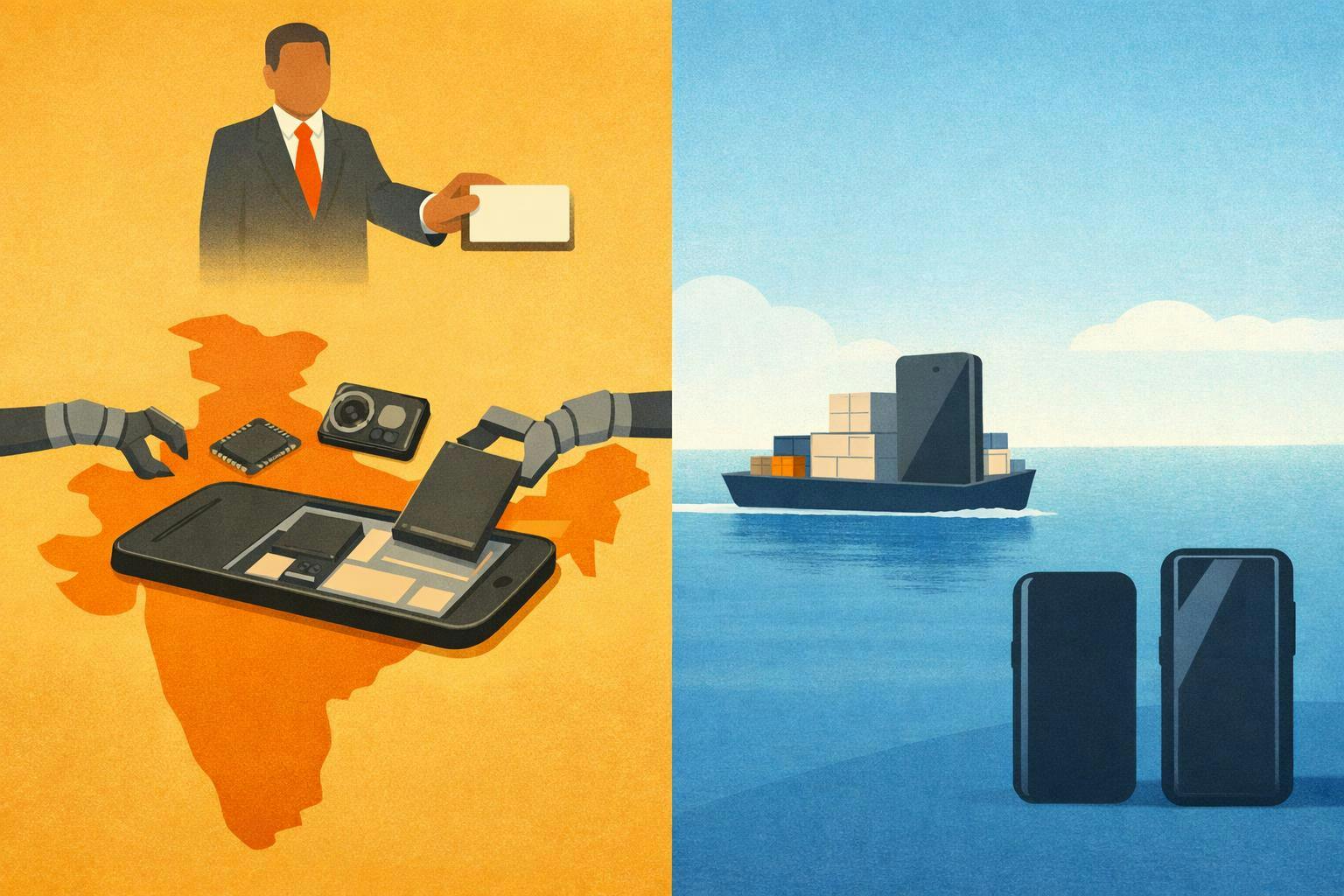
The focus has shifted toward "Local Value Addition." In the context of electronics, this means incentivizing the production of the "brain" and "skeleton" of devices—the Printed Circuit Board Assembly (PCBA), memory modules, and display panels. By linking subsidies to the percentage of local components used, the scheme forces a trickle-down effect. When a giant like Samsung or Apple is incentivized to source a PCBA locally, it creates a secondary market for smaller Tier-2 and Tier-3 suppliers within India.
This isn't just about domestic consumption. The "Smartphone export incentives" built into the scheme are designed to make India a global export hub. By lowering the effective cost of production through incentives, Indian-made goods become competitive on the shelves of New York, London, and Dubai.
Beneficiaries and Industry Impact
The list of companies approved under PLI 2.0 reads like a "Who's Who" of the global tech industry. Major global firms including Apple (through its contract manufacturers Foxconn, Wistron, and Pegatron), Samsung, Dell, and HP are the primary beneficiaries.
The impact on Apple is particularly striking. The tech giant has significantly ramped up its Indian operations, with expectations to reach $40 billion in production value by FY 2026-27. This isn't just a win for Apple; it’s a proof of concept for the entire Indian manufacturing sector.
However, the scheme isn't solely for global giants. It also carves out a significant space for "Domestic Champions" like Dixon Technologies. These companies act as a bridge, providing manufacturing services for both global brands and emerging domestic ones. By fostering these domestic players, India is ensuring that the intellectual property and manufacturing expertise gained through the PLI scheme remain within the country’s corporate ecosystem.
Current statistics show that 27 IT hardware manufacturers have already been approved, and many are in "Day Zero" readiness—meaning they are ready to begin or expand production the moment the fiscal year cycles.
Technical Breakdown: Incentives and Eligibility
To understand why PLI 2.0 is more effective, we need to look at the mechanics. The scheme provides an average 5% incentive on incremental sales of goods manufactured in India. But the devil—and the value—is in the details.
PLI 1.0 vs. PLI 2.0: The Evolution
| Feature | PLI 1.0 (Mobile Phones) | PLI 2.0 (IT Hardware/Electronics) |
|---|---|---|
| Primary Focus | Volume of production and assembly | Value addition and localization |
| Incentive Range | 4% to 6% | 3% to 5% (plus optional localization bonuses) |
| Tenure | 5 Years | 6 Years (flexible entry) |
| Localization Focus | Final assembly and basic components | PCBA, Power adapters, Enclosures, Memory |
| Budgetary Outlay | Focus on Mobile/Specific components | Broad-based with INR 17,000 Cr for IT Hardware |
Eligibility Tiers
The scheme categorizes applicants to ensure a level playing field:
- Global Companies: Required to make a minimum investment of INR 500 Cr and meet high incremental sales targets.
- Hybrid (Global/Domestic): Companies with a significant footprint but lower investment thresholds.
- Domestic Companies: Aimed at MSMEs with an investment threshold of just INR 20 Cr, ensuring that local entrepreneurs aren't boxed out by the giants.
The Localization Schedule (Infographic Style)
The genius of PLI 2.0 lies in its phased approach to manufacturing complexity:
- Year 1 (The Foundation): Focus on assembly and basic mechanical parts.
- Year 2-3 (The Core): Incentives kick in for PCBA (Printed Circuit Board Assembly) and battery packs.
- Year 4-6 (The Advanced Tier): Deep localization for Display Panels, Memory Modules, and Semiconductor components.
By staggering the requirements, the government allows companies to build their supply chains organically rather than demanding impossible shifts overnight.
Economic and Geopolitical Implications
The PLI 2.0 scheme is more than just a fiscal policy; it is a geopolitical statement. As the world looks for a "China Plus One" alternative, India is positioning itself not just as a consumer market, but as a reliable, high-tech factory for the world.
The economic multiplier effect here is massive. Economists estimate that for every direct job created in electronics manufacturing, 2.2 indirect roles are generated in the surrounding ecosystem—from logistics and packaging to food services and housing. With over 12.6 lakh jobs already attributed to PLI sectors, the social impact is profound.
Furthermore, this shift helps India manage its trade deficit. Historically, electronics were India's second-largest import item after oil. By boosting exports and increasing local value addition, India is moving toward a more balanced trade profile. The growth in global share from 1.2% to 3.75% may seem small in percentage terms, but in the context of the multi-trillion dollar global electronics market, it represents billions of dollars in shifting capital.
Expert Insight: "PLI 2.0 is not a traditional subsidy; it is 'Capital-Creating' expenditure. By rewarding performance rather than just existence, the government ensures that only the most efficient and scalable companies receive taxpayer support."
Challenges and the Roadmap Ahead
While the trajectory is positive, the road is not without bottlenecks. India's digital ecosystem is exploding, with 1.17 billion mobile subscribers driving massive demand for servers and data centers. Meeting this demand requires more than just factory floor space; it requires sustained investment in Research and Development (R&D).
Structural challenges remain:
- Logistics Costs: Despite improvements, the cost of moving goods within India is still higher than in competing nations like Vietnam or Thailand.
- Upstream Value Addition: While we are moving toward PCBA and memory, India still lacks a robust semiconductor fabrication ecosystem, which is the ultimate goal of the $10 billion "India Semiconductor Mission."
- Skill Gap: High-tech manufacturing requires a specialized workforce. Vocational training must keep pace with the technical requirements of PLI 2.0 factories.
The roadmap ahead involves shifting the focus from "Electronics" to "Deep Tech." As the 2.0 scheme matures, we can expect future iterations to focus even more on R&D credits and design-led manufacturing, where the high-margin intellectual property is created.
FAQ
Q: How does PLI 2.0 differ from the original PLI scheme? A: While the first version was focused largely on increasing the volume of mobile phone manufacturing, PLI 2.0 targets a broader range of IT hardware (laptops, tablets, servers) and places a much heavier emphasis on "local value addition." It rewards companies specifically for sourcing components like PCBAs and memory modules within India.
Q: Can small domestic companies benefit from this scheme? A: Yes. PLI 2.0 has specific tiers for domestic companies with much lower investment requirements (as low as INR 20 Cr compared to INR 500 Cr for global firms). This is designed to help Indian MSMEs grow into larger "Domestic Champions."
Q: What is the goal for India's electronics production by 2026? A: The Indian government has set a target of reaching a $300 billion domestic electronics market by 2026, with a significant portion of that destined for global exports.