Quick Facts
- Gold Status: Trading at record highs between $4,500 and $5,000/oz in early 2026.
- The Yield Factor: High real interest rates have pushed the opportunity cost of holding gold to a decade-high.
- Market Milestone: Global gold reserves have hit 36,000 metric tons ($4 trillion), finally edging out the $3.9 trillion held in foreign-held U.S. Treasuries.
- The Verdict: While gold remains a vital long-term hedge, U.S. Treasurys currently offer a "cleaner" safety trade by providing consistent income that bullion cannot match.
The 2026 Safe Haven Paradox
As we navigate the opening months of 2026, investors are facing a paradox that contradicts a century of financial intuition. Traditionally, when geopolitical tensions rise and inflation fears loom, gold is the undisputed king of the "safety trade." However, the current landscape tells a different story. While gold has surged to a nominal record of $4,500/oz, it is U.S. Treasurys that are winning the battle for strategic portfolio allocation.
The reason is simple but profound: U.S. Treasurys are outperforming gold because rising interest rates increase the opportunity cost of holding non-yielding gold, making interest-bearing bonds a more attractive safety play. In a world where you can capture a guaranteed yield of 5% or higher on a risk-free government asset, the "zero-coupon" nature of gold becomes a heavy burden for the modern portfolio.
For the long-term investor, the choice isn't about which asset is "better" in a vacuum, but which one serves the current macro environment. Gold is a store of value—a silent insurance policy. Treasurys, conversely, provide consistent income. In the high-volatility environment of 2026, that "retirement paycheck" from bond coupons is proving more valuable than the speculative upside of bullion.
The Opportunity Cost: Why Yields Matter More than Bullion
To understand why gold is underperforming bonds in terms of relative safety appeal, we have to look at the relationship between real yields and the price of the "yellow metal." Gold usually thrives when real interest rates (the interest rate minus inflation) are low or negative. When money in the bank loses purchasing power, people flee to gold.
What it means: Real Yields Real yields represent the actual return an investor receives after accounting for inflation. If a Treasury bond pays 5% but inflation is 3%, the real yield is 2%. When real yields are high, the "opportunity cost" of gold—the profit you miss out on by not holding bonds—becomes too high for many institutional managers to ignore.
In 2026, the "cleaner" safety trade favors assets that provide a cash flow. If you are an institutional manager looking to protect a multi-billion dollar pension fund, you need more than just a price hedge; you need liquidity and predictable returns to meet obligations. Gold is notoriously difficult to trade in massive sizes without moving the market, and it costs money to store and insure. Treasurys, however, pay you to wait out the storm. This is why gold tends to stall or underperform whenever the U.S. dollar strengthens alongside rising yields.
Oil Shocks and the Inflation Trap
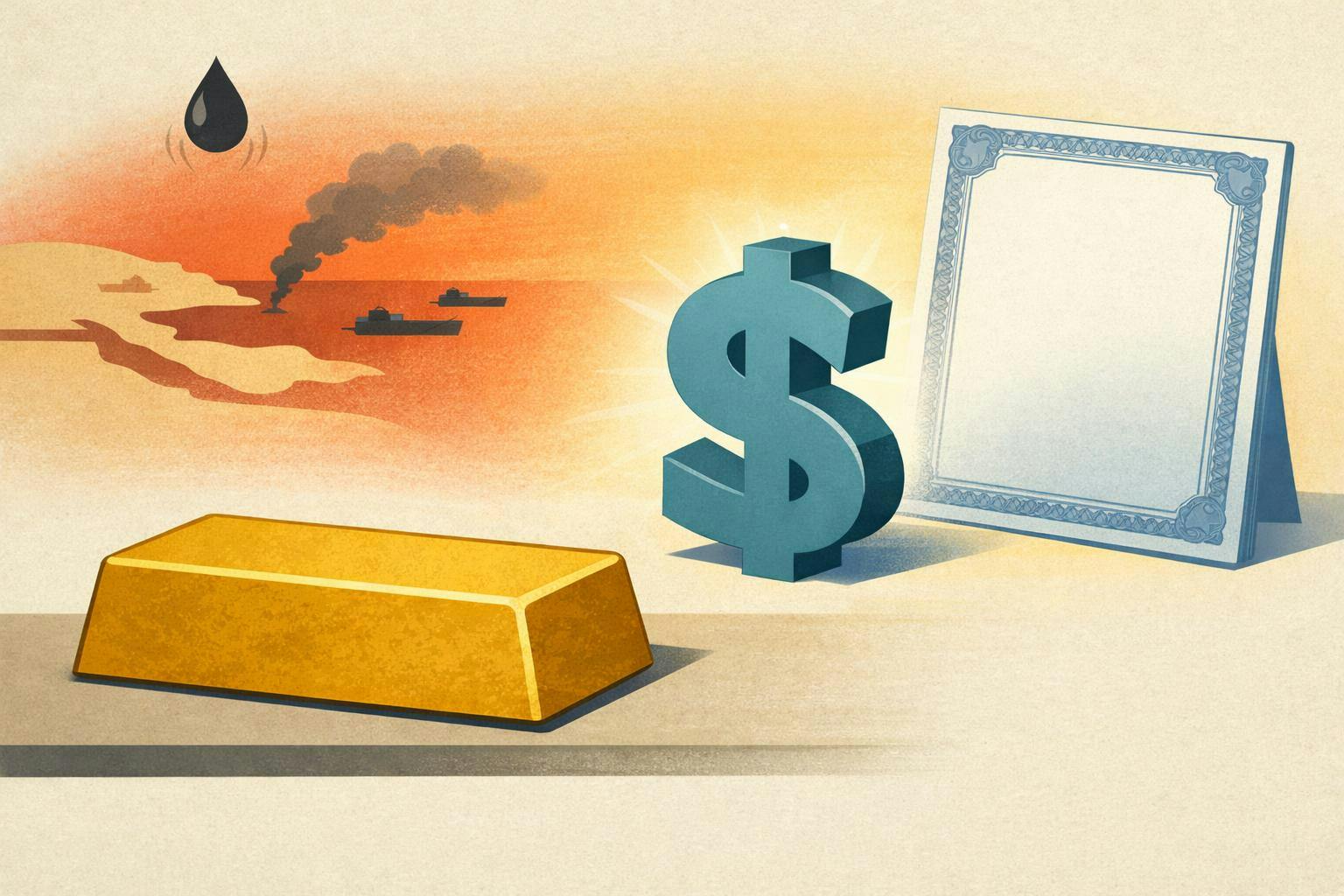
The current dynamic is being driven heavily by energy markets. During oil-driven inflation shocks, such as the 2025-2026 disruptions in the Strait of Hormuz, central banks are forced to keep interest rates elevated to prevent a wage-price spiral. This creates a unique trap for gold.
Normally, an oil shock would be "good" for gold as a hedge. But in the current cycle, the resulting "sticky" inflation has forced the Federal Reserve to maintain a "higher-for-longer" stance. This boosts the U.S. dollar and bond yields, frequently capping gold's upside despite geopolitical tensions. We saw a similar pattern during the 1979 energy crisis, but today’s high debt levels have made the market even more sensitive to interest rate fluctuations.
Investors are realizing that if inflation is caused by supply-side shocks (like oil), gold protects purchasing power, but Treasurys protect the portfolio's ability to generate cash. As long as the Fed remains hawkish to combat energy-led inflation, the yield on a 10-year Treasury will likely remain a more compelling "safe" bet than a bar of gold that pays nothing.
Central Bank Rebalancing: The $4 Trillion Milestone
We have reached a historic milestone in 2026. For the first time in the modern era, global gold reserves—valued at approximately $4 trillion—have surpassed the $3.9 trillion held in foreign-held U.S. Treasuries. This shift, driven largely by emerging markets like China, India, and Turkey, suggests a long-term desire to diversify away from the U.S. dollar.
However, for the individual investor, it is crucial to distinguish between what a central bank does and what a portfolio manager does.
- Central Banks: Are buying gold to diversify their sovereign risk and reduce reliance on the Western financial system. They have a 50-year horizon.
- Institutional Investors: Still lean on Treasury liquidity because the market for U.S. government debt remains the deepest and most liquid in the world.
While gold is a long-term store of value, Treasurys are preferred in the current market as a 'cleaner' safety trade that provides consistent income during periods of high real yields. When you need to exit a position in a hurry during a market panic, the Treasury market can handle trillions in volume with minimal "slippage." The gold market, while large, still lacks the same level of instant, friction-free liquidity.
Debt Concerns vs. Deep Liquidity
We cannot ignore the elephant in the room: the $38 trillion U.S. national debt. It is a staggering figure that has caused some erosion in trust. A recent 2025 World Gold Council survey indicated an 85% trust score for gold among global investors, compared to a 78% trust score for the U.S. dollar.
Despite these fiscal concerns, the "Safe Haven" crown hasn't slipped from the Treasury's head just yet. Why? Because safety is relative. In a global crisis, investors don't ask "is the U.S. debt-free?" They ask "where is my money most likely to be available and spendable tomorrow?"
The U.S. Treasury market remains the superior "crisis liquidity" asset because it is the foundation of the global collateral system. Banks use Treasurys to lend to one another; they don't use gold bars for daily repo transactions. Even with a lower trust score, the dollar remains the "least bad" option in a world of struggling fiat currencies.
| Metric | U.S. Treasurys (2026) | Gold (2026) |
|---|---|---|
| Yield/Income | High (5%+) | Zero (None) |
| Inflation Protection | Moderate (via TIPS) | High (Long-term store) |
| Liquidity | Extreme (Deepest in world) | High (But carries storage costs) |
| Counterparty Risk | Sovereign (U.S. Gov) | Zero (Physical asset) |
Portfolio Strategy: When to Pivot
As a portfolio strategist, my advice is rarely "either/or." Instead, it’s about "how much."
For most long-term investors in 2026, a 5-10% allocation to gold remains a prudent "insurance policy" against a systemic collapse of the dollar. However, for the "safety" portion of your portfolio—the part designed to protect you during a standard recession or geopolitical flare-up—Treasurys are the clear winner.
If interest rates begin to fall: That is your signal to increase gold exposure. When the Fed pivots and yields drop, the opportunity cost of gold vanishes, and its price can skyrocket. If inflation stays "sticky" and rates stay high: Stay heavy in Treasurys. Let the government pay you 5% or more while you wait for a better entry point into the gold market.
FAQ
Q: Is gold a bad investment in 2026? A: Not at all. Gold is at record highs for a reason—it’s the ultimate hedge against fiscal instability. However, from a tactical "performance" standpoint, it is currently more expensive to hold gold than it is to hold interest-bearing bonds.
Q: Should I sell my gold to buy Treasurys? A: Rarely is a total exit the right move. Think of gold as your "deep insurance" and Treasurys as your "working capital." If your portfolio lacks income-generating assets, shifting some gold into Treasurys while yields are at 2026 milestones is a logical move.
Q: How does the U.S. debt affect my Treasury bonds? A: While the $38 trillion debt is a long-term risk, in the short term, it creates a high supply of bonds, which keeps yields high. For an investor seeking income, these high yields are actually an advantage, provided the U.S. continues to meet its interest payments—which it has never failed to do.
Strategic Takeaway: In the high-stakes environment of 2026, don't let the shine of record-high gold prices distract you from the mathematical reality of yields. A safe haven isn't just a place to hide your money; in a smart portfolio, it’s an asset that works for you. Currently, the U.S. Treasury is the hardest-working safe haven on the map.